Spring Spotlight!!

ATech Training • February 23, 2026

Powering the Future: Innovation and Expansion in EV Batteries

Author: Jeff Bogue

Electric vehicles (EVs) have steadily gained traction in the global automotive market over the past decade. While adoption has progressed more slowly than many early projections predicted, growth is now accelerating. In 2015, just over 1% of all vehicles sold worldwide were electric. By 2024, that figure had risen to approximately 20%, with projections for 2025 approaching 25%.


Global market share is influenced heavily by countries that have aggressively embraced EV technology. Norway leads the world, with nearly 90% of new vehicle sales now electric. Sweden and Denmark have also seen adoption rates approaching 60% in recent years. EVs are clearly not a passing trend. As adoption increases, the technology powering these vehicles has become both big business and increasingly sophisticated.
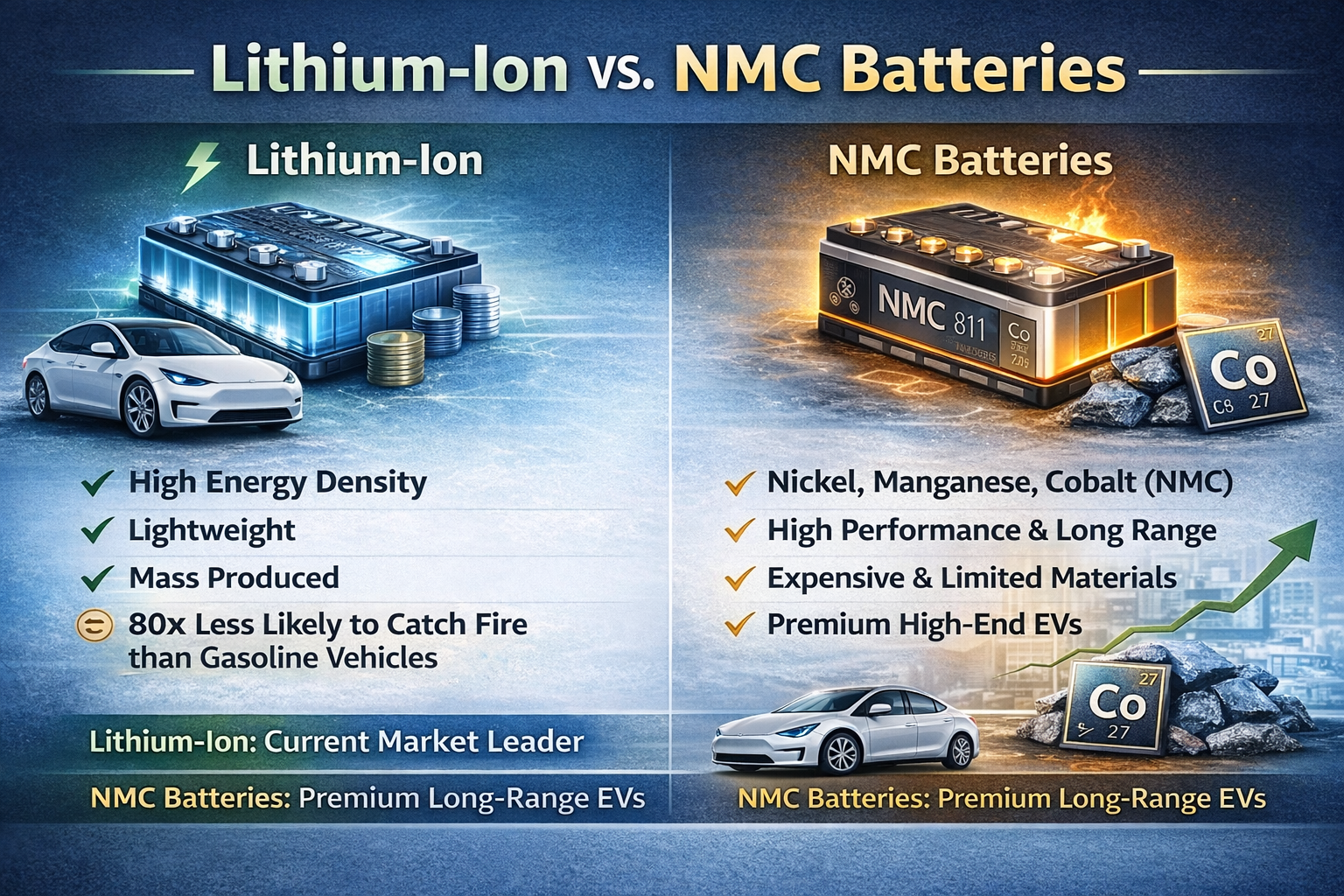
The EV battery market is currently dominated by lithium-ion batteries. These batteries offer high energy density, lightweight construction, and benefit from a mature, large-scale manufacturing infrastructure capable of meeting growing demand. Although lithium-ion batteries have proven to be reliable and generally safe, viral internet videos of thermal runaway incidents have fueled public concern. What is often overlooked, however, is that gasoline-powered vehicles are estimated to be roughly 80 times more likely to catch fire than electric vehicles.


Nickel Manganese Cobalt (NMC) batteries have become the standard for high-end, long-range EVs. They deliver excellent performance and energy density but come with higher manufacturing costs due to their reliance on expensive and limited materials such as cobalt. In response, many manufacturers are working to reduce dependence on rare and costly materials, including rare earth elements used in electric motors. Progress in this area is gradual, but emerging technologies and laboratory research continue to show promise.

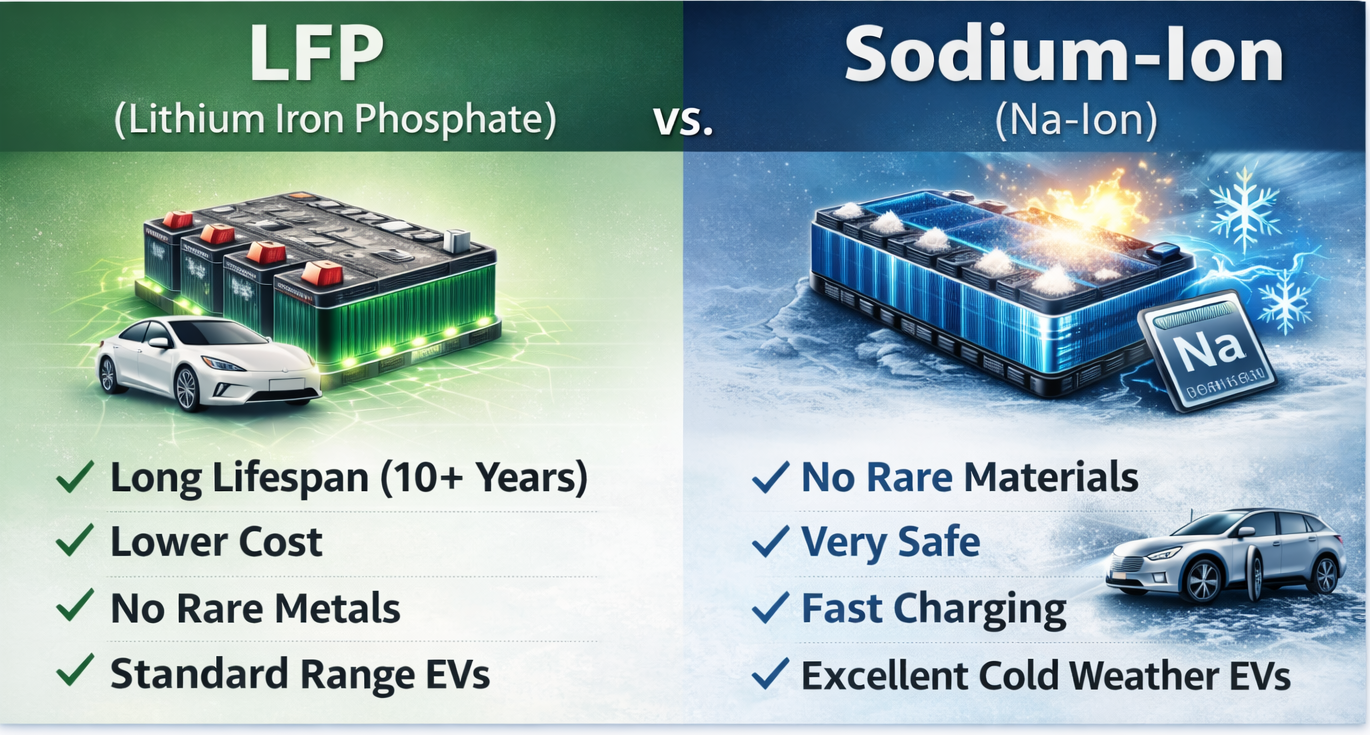
Lithium Iron Phosphate (LFP) batteries have become firmly established in the automotive industry, particularly in standard-range EV models offered by manufacturers like Tesla. While LFP batteries have lower energy density than traditional lithium-ion variants, they offer significant advantages: long service life often exceeding 10 years under normal conditions and lower production costs due to the absence of rare metals. However, their heavier weight relative to energy output and reduced performance in cold weather remain challenges, as is common with most lithium-based chemistries.


Sodium-ion (Na-ion) battery technology has recently gained significant momentum. Advances in manufacturing processes and cell architecture have positioned sodium-ion batteries as strong candidates to join the top tier of EV battery technologies.

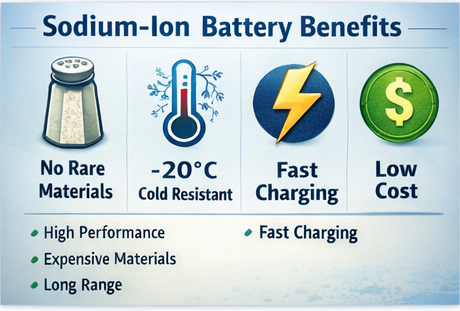
While sodium-ion batteries do not yet match lithium-based systems in energy density resulting in larger and heavier battery packs they offer compelling advantages. They require no rare materials, instead relying on abundant sodium derived from salt. This makes them comparatively inexpensive and more sustainable. Additionally, sodium-ion batteries demonstrate exceptional safety characteristics and maintain high efficiency in cold temperatures, performing far better than many lithium-based alternatives in freezing conditions. They can also accept rapid charging rates with impressive efficiency. Mass production of sodium-ion batteries began recently in several Chinese manufacturing facilities, and vehicles equipped with this technology are already being introduced into European markets.


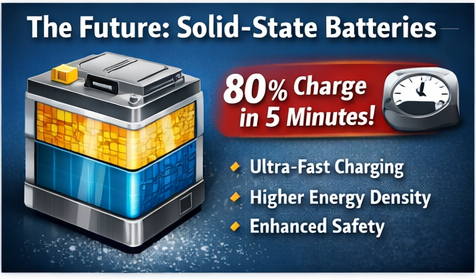
The technology that many consider the ultimate goal of battery development is solid-state design. Solid-state batteries replace the liquid electrolyte found in conventional lithium-ion cells with a solid material, potentially delivering dramatic improvements in energy density, safety, and charging speed. Despite years of research, solid-state technology remains under development, though several companies are making substantial progress.

Finnish startup Donut Lab has claimed its solid-state battery can reach an 80% charge in just five minutes a bold assertion that has reportedly received validation through third-party testing. Nissan has also announced plans to introduce solid-state batteries in its production vehicles within the next few years, though details remain closely guarded. If solid-state batteries begin entering the market at scale, they could represent a true game changer not only for electric vehicles but also for residential and commercial energy storage

As the EV industry continues to evolve and expand, the demand for trained and qualified technicians will only increase. Battery technologies are advancing rapidly, and servicing these vehicles requires specialized knowledge and equipment. ATech Training has supported EV education for many years by providing industry-relevant training equipment. However, the growing market calls for more skilled graduates entering the workforce. The future of transportation is electric and there is plenty of room for the next generation of technicians to power it forward.


Teaching Essential EV Systems In Your Classroom

Dive into the future of automotive education by checking out ATech Training Youtube video!!


View Product Info Request A Quote

Upcoming Events

Trade Shows and Conferences

Get Ready!! ATech Training has an exciting lineup of events coming your way in the months ahead! Don't miss the opportunity to learn, connect, and grow with us!

March

3/5/2026-3/8/2026:   Vision Hi-Tech Training & Expo: Overland Park Convention Center, Leawood, KS

3/12/2026: MATA: Macomb Community College, Warren, MI

3/13/2026: RMATS: Front Range Community College, Westminster, CO

3/26/2026-3/27/2026: ICAIA: Southern Illinois University, Carbondale, IL

3/29/2026-4/1/2026: ATEC: Hilton Portland Downtown, Portland, OR


June

6/1/2026-6/5/2026: SkillsUSA: Georgia World Congress Center, Atlanta, GA

6/8/2026-6/12/2026: Florida ASE Conference: Orange Technical College - South Campus, Orlando, FL

6/15/2026-6/18/2026: Automotive Educator Conference:  Sacramento, CA


July

7/15/2026-7/17/2026: UNOH Instructor Conference: University of Northwestern Ohio, Lima, OH

7/20/2026-7/24/2026: ASE Instructor Conference: Embassy Suites by Hilton Dallas Frisco Hotel & Convention Center, Frisco, TX


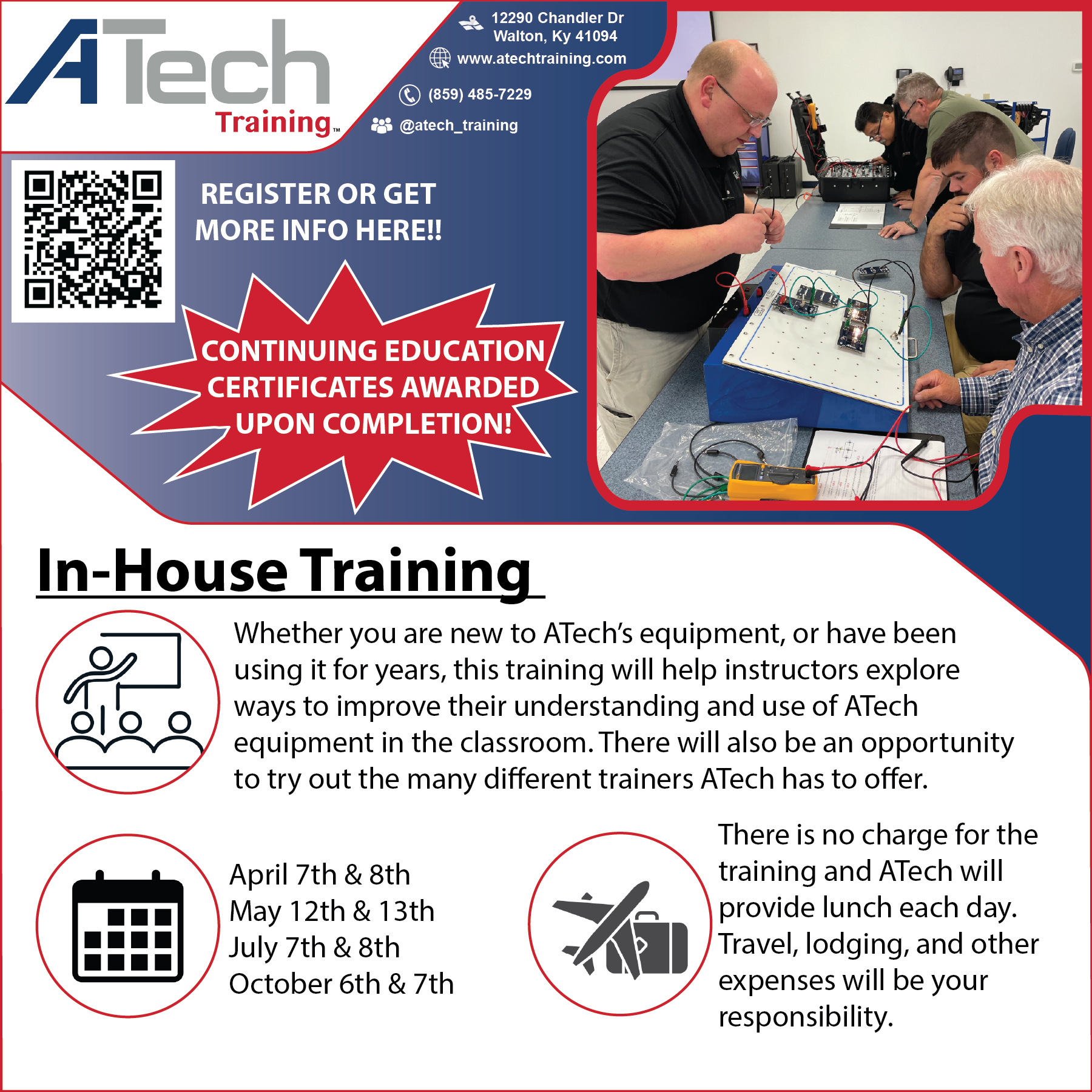
In House Training Poster
Register for In-House Training

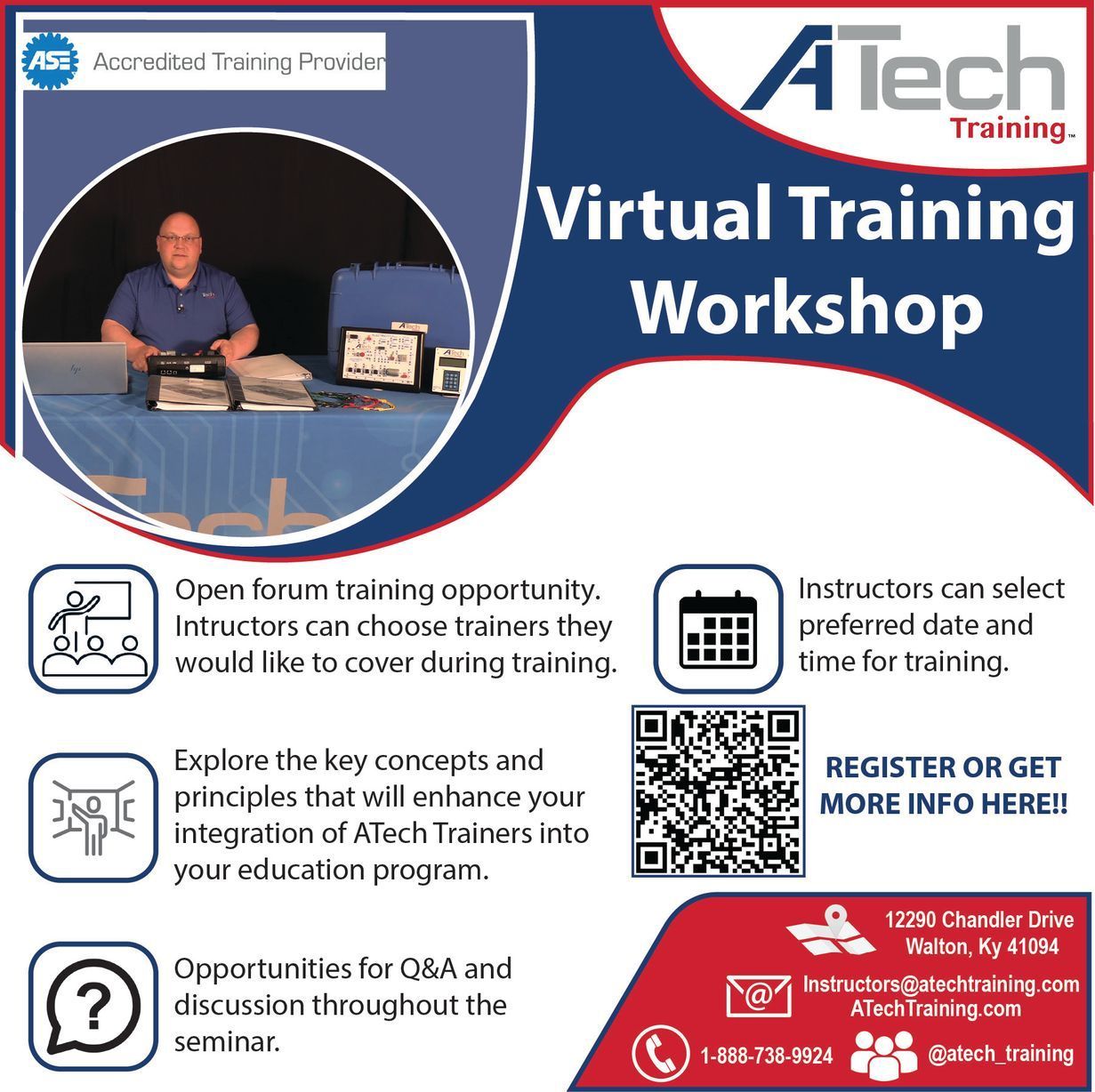
Virtual Training Poster
Register for Virtual Training

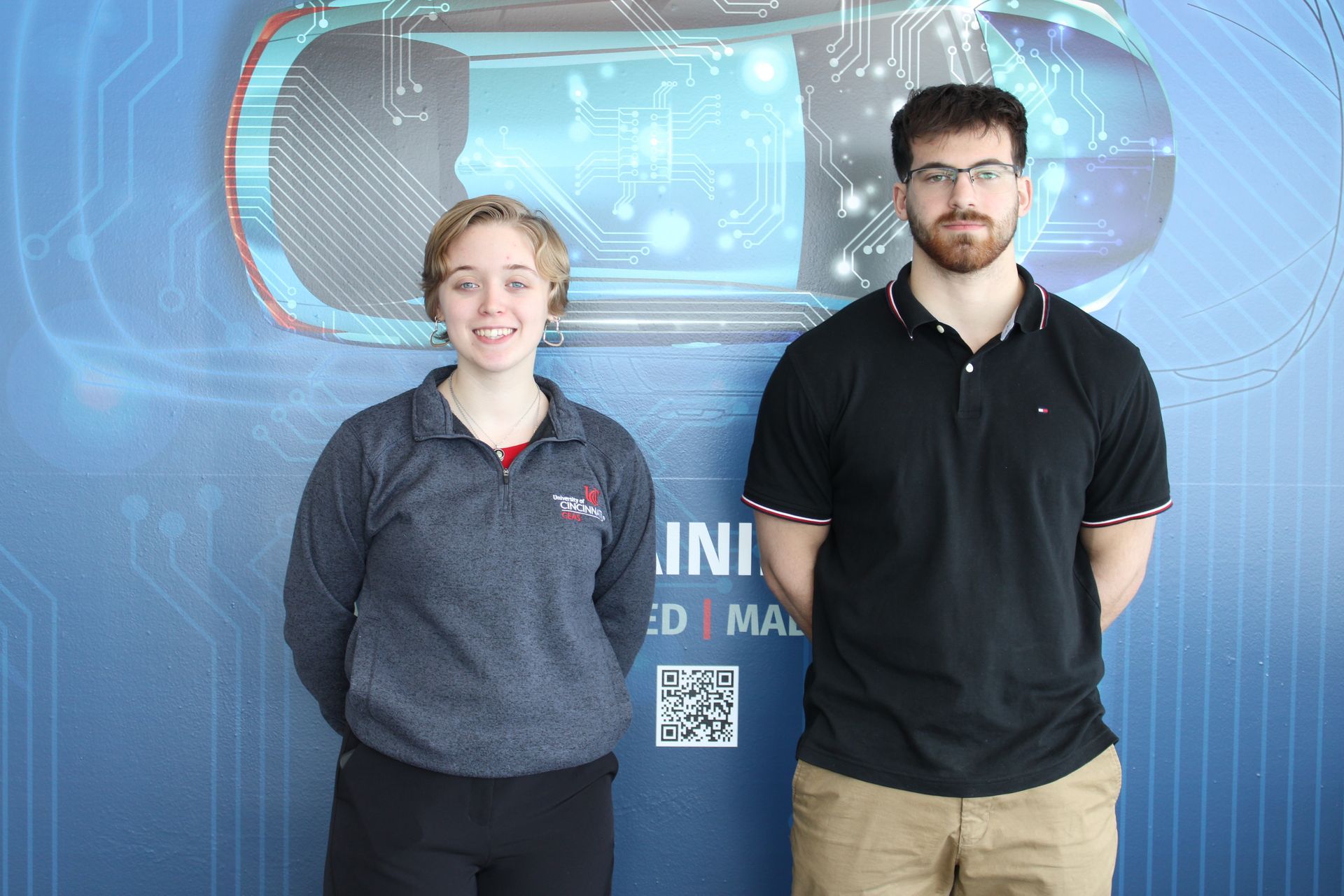
Welcome Our Spring Co-Op Students!

ATech is excited to welcome Kylie and to welcome back Noah, students from the University of Cincinnati – College of Engineering and Applied Science, to our engineering team this spring!


Through our Co-Op Program, Kylie and Noah will work closely with our engineering team, gain valuable hands-on experience, and contribute to meaningful, real-world projects.


We’re looking forward to a great semester of learning, collaboration, and innovation.


Welcome aboard, Kylie and Noah!!


Contact Us!

If interested in any of our training or products, please contact us!

If you would like ATech Training to highlight your program on social media or in our next newsletter contact us.


Contact Us Email Us Call Us
By ATech Training October 3, 2025
Upcoming Events
By ATech Training June 2, 2025
Stop by ATech Training's Booth at NACAT to see these trainers in action!!
By ATech Training February 3, 2025
The automotive industry is an ever-changing landscape of engineering innovation. As always, this atmosphere of change has once again made the attempt to lurch forward. There are multiple changes and challenges coming for automotive technicians in the near future. Some small, some large, and some totally ground-breaking. I won’t be going too far into the technology of some of these innovations as some are not only complicated, but quite difficult to describe. I will, however, do my best. As a round-up of older developments let’s take a look at these technologies from Nissan, Konigsegg and Liquid Piston that seemed far-fetched only a few years ago. Seven or eight years ago Nissans developed a variable compression engine that changed the stroke of the piston as needed to alter the performance characteristics. Thus, aiding both performance and fuel economy. When a change in compression is needed, an actuator motor adjusts the pistons position changing the compression from 14:1 (economy) to 8:1 (performance). This engine is now offered in many of their newer vehicles and will be installed in all of their Nissan Murano SUVs in the 2025 model year. It is an engineering marvel that seemed like magic only seven or eight years ago. The engine has proven itself fairly reliable and Nissan is hoping that it will perform as their new standard looking forward. Of course, their engineers are now on to greater things.
A close up of a motorcycle engine with flames coming out of it.
By Jeff Bogue October 25, 2024
What's Old Is New...
By Jeff Bogue December 12, 2023
I have been dreaming about and studying engines and engine performance of cars, trucks, and motorcycles for the better part of 45 years. It’s a hobby. It keeps me busy on cold winter evenings. It’s something that has become a large part of my life and, like playing with dogs, is something I love to do. I have written about engines and the engineering that is involved in them for the last 15 years, and I have always been forward-thinking. When a new engine is being lauded by the manufacturers as the next big thing, I read all about it and report those findings here. In the past, I have written about every one of the engines in this article at one time or another, and each one was glowingly revealed by the engineers with the statement “We can expect these engines in our cars in the next few years”. Well, a few years have passed and now most of these engines ARE in our cars and trucks and should be reaching repair shops and dealerships now. We just haven’t heard that much about them because people, as a general rule, really don’t care that much about which engine is in their car if it gets good gas mileage, is reasonably reliable, and has a little umph to get on the highway. Well, that is not us. We care. We study it. It’s what we do and why you are where you are reading this article. Without further ado, let us look at the “Engines of the Future” that you can buy (and service) now.
An electrician is working on an electrical box with a multimeter.
By Jim Wilson May 3, 2023
***Reprinted with permission of author***
By Jeff Bogue October 12, 2022
The world is changing. The Automotive Industry is changing. The Hot Rodding industry is changing...
By Michael Smyth February 27, 2022
...each new year will bring new challenges.
By Jeff Bogue December 8, 2021
There was a time when you could troubleshoot a good portion of your automotive issues with a set of wrenches and a vacuum gauge.
By Michael Smyth November 17, 2021
New vehicles mean new technologies,  new tools to buy, and new skills to learn.